
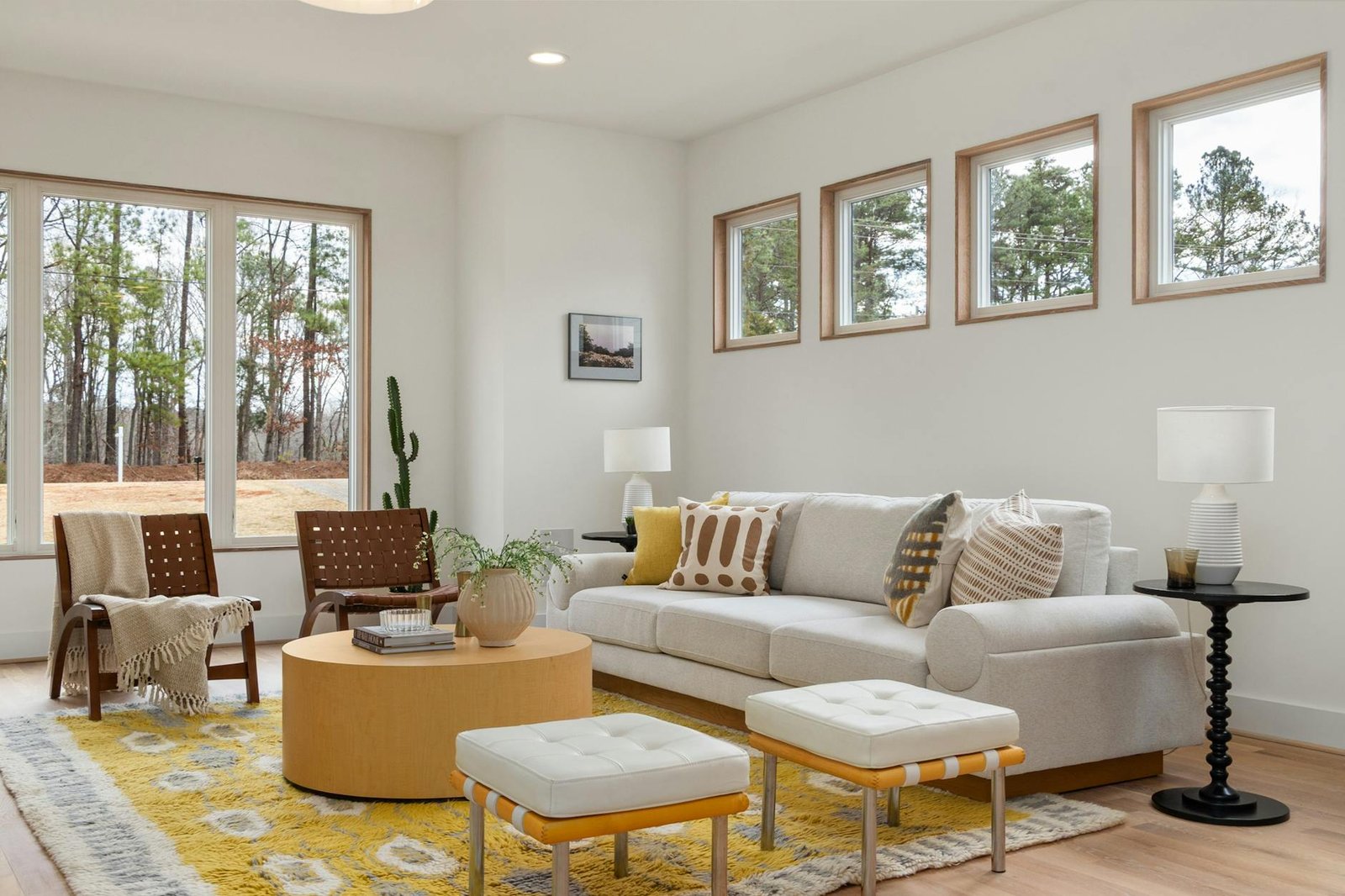
Some rooms feel valuable before a buyer notices the countertops, the sofa brand, or even the square footage. They read as calm, legible, and cared for. That reaction is not random. Buyers use fast visual shortcuts to decide whether a space feels easy to live in, easy to maintain, and worth paying for. In practice, elegance usually comes less from luxury spending and more from reducing friction: fewer visual decisions, a clearer layout, better light, and obvious upkeep. That lines up with research on rapid architectural judgment and processing fluency, along with housing-industry data showing that organized, staged rooms help buyers picture themselves in a home. (frontiersin.org)
TL;DR
- Elegant rooms tend to feel valuable because they are easier to process at a glance. Clear layout, coherent scale, and fewer competing elements create instant aesthetic pleasure. (frontiersin.org)
- Buyers often read light, openness, and order as signs that a home is current and well cared for, not just well decorated. (myhome.freddiemac.com)
- Before buying new decor, fix maintenance signals first: scuffed paint, chipped trim, tired lighting, loose hardware, and heavy window treatments. Those issues can make a room feel cheaper very quickly. (nar.realtor)
- Online presentation matters. NAR says 81% of buyers rated listing photos as the most useful feature in their online home search, so a room has to read well through a phone camera, not just in person. (nar.realtor)
- Use the V.A.L.U.E. Room Scorecard in this article to decide where money should go first.
Why elegance registers so fast
One useful clue comes from architectural aesthetics research. In a 2021 study, people shown images of architectural spaces for only 200 milliseconds still preferred rooms with higher ceilings, greater openness, and curvilinear contours over lower, more enclosed, rectilinear ones. That matters because buyers do not walk into a room like careful lab technicians. They form a first impression almost immediately. (frontiersin.org)
The broader psychology is often explained through processing fluency. Put simply, when a space is easier for the brain to decode, people tend to experience more immediate aesthetic pleasure. A room with one clear focal point, a coherent palette, and furniture that makes visual sense feels more expensive partly because it feels easier. The buyer is not spending mental energy sorting out what belongs, what clashes, or where to look. (frontiersin.org)
Real-estate data points in the same direction. In NAR’s 2025 Profile of Home Staging, 83% of buyers’ agents said staging made it easier for buyers to visualize a property as a future home. Sixty percent said staging affected some buyers’ view of the home, and another 26% said it affected most buyers’ view. Freddie Mac also notes that staging can build an emotional connection and make a home feel newer or more spacious. (nar.realtor)
Openness is not just a design-magazine preference, either. In NAHB’s 2021 edition of What Home Buyers Really Want, 85% of buyers wanted an open arrangement between the kitchen and dining room, and 79% wanted openness between the kitchen and family room. Even if you cannot knock down a wall, the visual lesson is still useful: shared spaces usually feel more valuable when sightlines are cleaner and movement is easier. (nahb.org)
The V.A.L.U.E. Room Scorecard
To assess a room, use this room scorecard developed by V.A.L.U.E. Assign either 0, 1 or 2 points in each of the four (4) categories, as the objective is not to reach perfection, but to find the fewest changes that will impact the buyer’s first impression in the shortest time possible.
- V – Visible breathing room: Can you see open floor area, clear tabletops, and a clean path through the room? Aim for surfaces that are edited, not full.
- A – Alignment and scale: Does the rug fit the seating area? Do key pieces line up logically? Is the furniture sized for the room rather than too tiny or too bulky?
- L – Light layering: Does the room get daylight, and does it also have flattering lamp light at eye level instead of relying on one harsh overhead fixture?
- U – Upkeep signals: Do paint, trim, grout, switches, hardware, cords, and textiles suggest care rather than deferred maintenance?
- E – Edited palette: Do colors, woods, metals, and shapes repeat enough to feel intentional, or does every item look like it came from a different house?
According to the scoring system, rooms with a score of 8 to 10 read very elegantly, even if nothing inside the room cost much to put together. Rooms with a score of 5 to 7 may be fine, but will tend to be boring or forgettable, while rooms with a score of 0 to 4 where most people spend too much decorating but don’t get what they want will typically have problems with clutter, scale, lighting or visible wear.
Where design becomes a money signal
Buyers rarely separate style from condition as neatly as sellers do. A scuffed wall, tired trim line, wobbly cabinet pull, or badly patched nail hole may be a small repair, but it often gets read as part of a larger maintenance story. That helps explain why, in NAR’s 2025 Remodeling Impact Report coverage, the top pre-listing projects Realtors recommended were painting the entire home, painting a single interior room, and installing new roofing. Freddie Mac makes the same point in softer terms: minor updates can make a home feel newer and more spacious. (nar.realtor)
Light multiplies that effect. NAR’s seller guidance says buyers want light and views, not dated heavy drapes, and NAR reports that 81% of buyers rated listing photos as the most useful feature in their online home search. A room that feels dim, low, and visually blocked will usually underperform twice: once in the photos and again in person. (nar.realtor)
The reason why elegant rooms tend to be less busy or more restrained in style is because of this. One large, bold area rug will read much better than two smaller layered rugs from a distance. One bold cohesive art grouping will read stronger than five separate and scattered pieces of art. Repetition is another reason why rooms that contain more than one of the same wood tone, metal finish, or shape appear to have a greater degree of compositional integrity than those that do not.
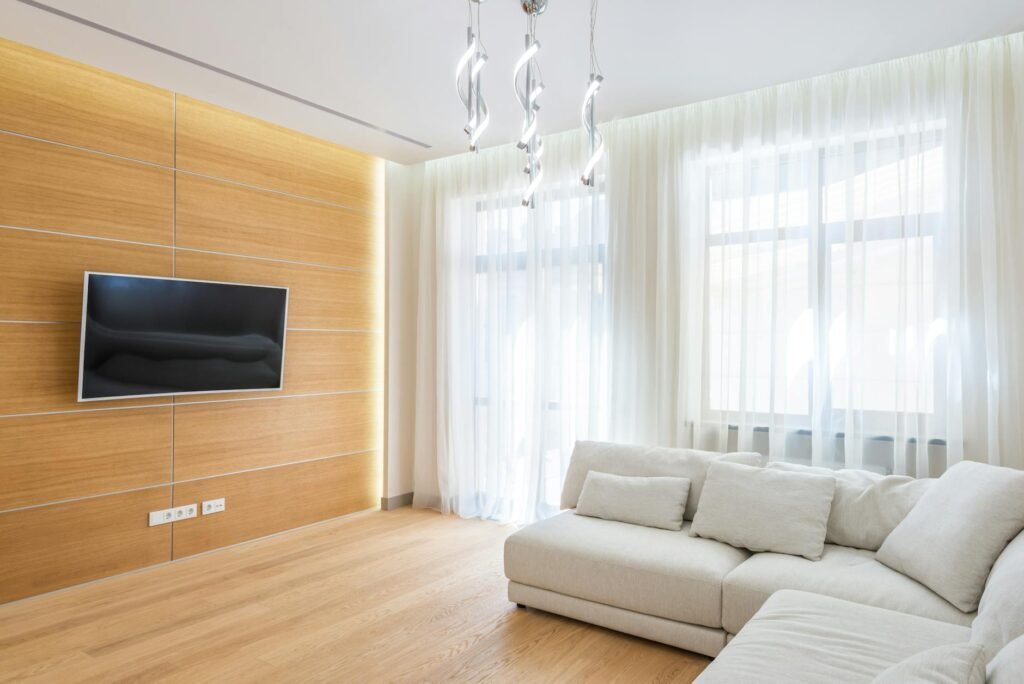
A $2,500 reset that changes the read of the room
Consider a composite seller with a 14-by-18-foot living room in a suburban home expected to list around $465,000. The room is not ugly. It is just ordinary in an expensive-looking way: dark curtains mounted low, a 5-by-7 rug floating under the coffee table, two undersized lamps, mismatched wood tones, crowded shelves, and baseboards with visible scuffs. That kind of room matters because NAR’s 2025 staging report says the living room was the most commonly staged room, at 91%. (nar.realtor)
Instead of buying trend pieces, the seller spends the budget this way: $650 on patching and repainting walls and trim, $225 on a higher curtain rod and simple light-filtering panels, $425 on a properly sized 8-by-10 rug, $300 on two matching lamps and warm LED bulbs, $250 on haul-away and off-site storage for extra furniture and decor, $350 on one better-scaled secondhand accent chair and a refinished coffee table, and $300 on minor repair details like outlet covers, loose hardware, caulk, and touch-up supplies.
Nothing there is glamorous. But the room’s V.A.L.U.E. score could plausibly move from 4 out of 10 to 8 out of 10 because the buyer now sees more floor, better light, cleaner lines, and fewer signs of neglect. Just as important, the room photographs better from the doorway. By contrast, the same $2,500 spent on a statement chandelier, new throw pillows, more art, and another side table could leave the room just as cramped and visually noisy as before.

Fix this before you buy more decor
| What buyers notice | What they often infer | Best first move | What to postpone |
|---|---|---|---|
| The room feels dark | Smaller, older, or less cared for | Remove heavy window treatments, hang curtains higher, add warm lamp light | A dramatic light fixture |
| Too many small items on every surface | Cramped, busy, hard to maintain | Edit out 30% to 50% of accessories and clear the largest surfaces first | Buying more storage furniture |
| Furniture sits on a tiny rug or no rug | The room is awkwardly sized | Use one larger rug or fewer pieces with better spacing | Extra accent chairs |
| Scuffed paint, chipped trim, loose hardware | Deferred maintenance elsewhere | Patch, paint, tighten, recaulk, and replace the obvious small failures | Wallpaper or custom millwork |
| Too many metals, woods, and shapes | Pieced together rather than intentional | Repeat two finishes and one dominant shape language | Replacing every item at once |
| No clear focal point | The room lacks confidence | Center the room around the best feature: window, fireplace, art wall, or conversation area | Multiple competing moments |
The mistakes that quietly cheapen a room
Most rooms do not miss because the budget was too small. They miss because the money went to the wrong layer of the problem.
- Buying accessories before removing clutter already in the room.
- Using rugs that are too small, which makes furniture look temporary and the room look chopped up.
- Blocking windows with dark, heavy, or low-hung drapery.
- Treating elegance as all-neutral sameness, so the room ends up flat instead of calm.
- Ignoring visible wear because buyers can fix it later. Buyers often price in more risk than the repair actually costs.
- Mixing every metal finish and wood tone once instead of repeating a few deliberately.
- Overspending on a trendy statement piece when the room’s real problem is layout, light, or upkeep.
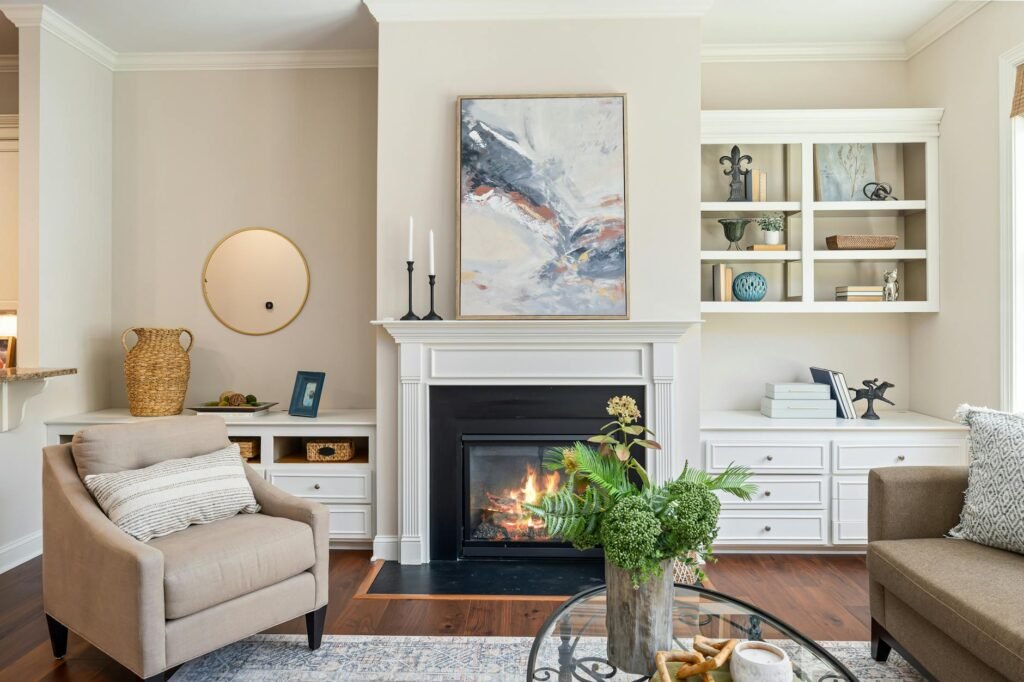
When the room has a bigger problem than styling
As sophisticated as looks might be, they can’t completely compensate for the negative impact of having an odor of pets, bad flooring, drafty windows, non-functional circulation patterns; poor ceiling texture; or an overall layout that will not allow for a full size piece of furniture. Styling will enhance the presentation however; buyers will still perceive the flaw and take steps to protect their interests by reducing the amount they will pay.
When your initial strategy fails, you must attempt a backup method. For those selling: address the single defect highlighted in the agent feedback preceding staging of other issues. For those owners who have no intention of selling; increase the comfort of your current home by utilizing improved lighting, added cleanliness of store spaces/accessories, reduction of noise through the use of window coverings, and using furniture designed to support your lifestyle. For those renting, leverage removable solutions such as drapes, table lamps, area rugs, groupings of artwork, etc., along with stringent editing. While architectural deficiencies cannot be recreated; the read of a room can be improved.
A one-week reset before photos or showings
- Empty the room down to about 70% of what is currently in it. Start with side surfaces, open shelving, and anything smaller than a breadbox.
- Stand in the main doorway and choose one focal point. If you cannot name it in one second, the room needs stronger hierarchy.
- Score the room from 0 to 2 on each V.A.L.U.E. category before you buy anything.
- Fix neglect signals first: burned-out bulbs, paint chips, crooked hardware, dingy switch plates, visible cords, and loose textiles.
- Correct scale next. The biggest wins usually come from the rug, curtain height, and removing one excess furniture piece.
- Layer the light. Aim for daylight, overhead light, and at least one flattering lamp source at eye level.
- Take fresh phone photos from the doorway and from seated height. Anything that jumps out in the photo is more important than what feels precious in person.
How to pressure-test the result
Do not trust your eyes alone after a long project. Pressure-test the room the way a buyer will see it. That matters because NAR says listing photos are the most useful online search feature for 81% of buyers, and early engagement helps a listing keep showing up in search results and alerts. If the room does not read clearly in a quick photo review, it is not ready yet. (nar.realtor)
- The 10-second scroll test: Look at one room photo on your phone for 10 seconds. If your eye lands on cords, clutter, or a dead corner first, fix that before anything else.
- The grayscale test: Convert the image to black and white. If the room still feels busy, the problem is contrast and clutter, not color.
- The three-word test: Ask a friend to describe the room in three words after seeing one photo. If you hear cluttered, dark, random, or small, the room is not reading elegant yet.
- The score movement test: Re-run the V.A.L.U.E. score after every purchase. If a new item does not improve the score, it was probably not the right buy.
Bottom line
Rooms feel instantly valuable when they deliver four things at once: easy visual order, enough breathing room, flattering light, and evidence of care. That is the buyer psychology behind elegance. The highest-impact moves are usually not the showiest ones. They are paint, repair, editing, scale correction, and better lighting, which is exactly why staging and pre-listing paint work keep showing up in real-estate guidance. (nar.realtor)
Is an elegant room the same as a minimalist room?
A room can have all of those characteristics while still being elegant. The important test is: does the eye recognize the room quickly? If the answer is yes, you have a focal point in a consistent scale, you have an edited palette to work with, and you do not have any distractions related to maintenance.
What is the cheapest change that usually improves perceived value first?
In many rooms, it is some combination of decluttering, touching up paint, improving lamp light, and removing heavy window treatments. Those fixes can change both the in-person feel and the photo quality without requiring a remodel. (nar.realtor)
Should I buy new furniture before listing my home?
Usually only if the current furniture is badly scaled, heavily worn, or making the room read smaller than it is. Often the better move is to remove pieces, rent a few staging items, or replace one obviously wrong item instead of refurnishing the whole room. (nar.realtor)
Do bold colors automatically hurt a room’s value?
Not automatically. The bigger issue is whether the color scheme feels coherent and broadly livable. For resale, the goal is usually to reduce buyer friction, not to maximize personal expression, so fresh, coordinated paint tends to work better than highly specific taste. (myhome.freddiemac.com)
Can renters use this approach without renovating?
Yes. Focus on removable levers: curtain height, lamp light, rug scale, artwork grouping, fewer accessories, hidden storage, and more consistent finishes. Renters often get a strong result by editing harder than owners do.
How do I know when to stop spending?
Stop when the room photographs clearly, the V.A.L.U.E. score improves, and the next dollar would mostly buy novelty rather than clarity. If you are selling, ask a local agent which three visible issues are most likely to hurt showings or offers, fix those, and pause there. (nar.realtor)
References
- National Association of Realtors: Profile of Home Staging – https://www.nar.realtor/research-and-statistics/research-reports/profile-of-home-staging
- National Association of Realtors: Top Remodeling Projects for Homeowner Satisfaction and Cost Recovery Revealed in NAR 3 – https://www.nar.realtor/newsroom/top-remodeling-projects-for-homeowner-satisfaction-and-cost-recovery-revealed-in-nar-report
- Freddie Mac My Home: What You Should Know About Staging Your Home – https://myhome.freddiemac.com/blog/selling/what-you-should-know-about-staging-your-home
- National Association of Realtors: How to Maximize Online Visibility for Every Listing – https://www.nar.realtor/magazine/real-estate-news/sales-marketing/how-to-maximize-online-visibility-for-every-listing
- National Association of Realtors: How To Attract More Buyers – https://www.nar.realtor/magazine/tools/client-education/handouts-for-sellers/how-to-attract-more-buyers
- National Association of Home Builders: What Home Buyers Really Want, 2021 Edition summary PDF – https://www.nahb.org/-/media/D02B3E48ABB5401D891ACDC185723E1B.ashx
- Frontiers in Psychology: The Influence of Viewing Time and Color on Architectural Aesthetic Judgment – https://www.frontiersin.org/journals/psychology/articles/10.3389/fpsyg.2021.752996/full
- Frontiers in Psychology: Aesthetic Pleasure versus Aesthetic Interest: The Two Routes to Aesthetic Liking – https://www.frontiersin.org/journals/psychology/articles/10.3389/fpsyg.2017.00015/full