
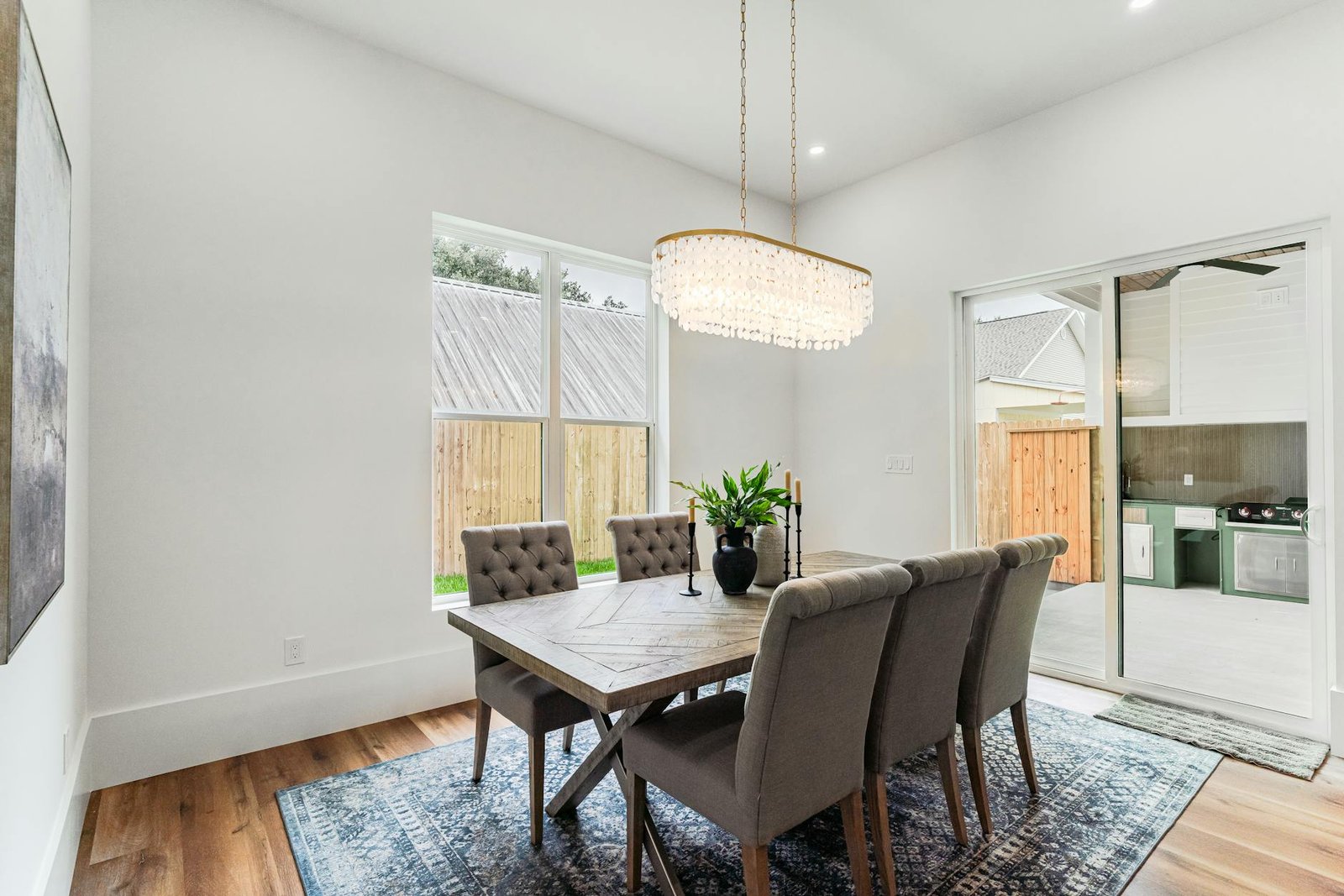
If a dining room looks polished but still feels like a place nobody would linger, the problem usually is not the centerpiece, wall art, or paint color. It is that the room has been staged to prove capacity instead of comfort. Sellers leave the table leaf in, keep every matching chair, and crowd the walls with a buffet, cabinet, or bar cart. The result is a room that reads formal and tight, when what buyers want to picture is an easy meal with people they like. That matters because home staging is mainly about helping buyers imagine themselves living there, and dining rooms are still one of the rooms agents stage most often. (nar.realtor)
That distinction matters financially too. Selling a home is already expensive, and staging budgets can get wasteful fast if you solve a layout problem by shopping for more decor. NAR’s 2025 profile reported a median spend of $1,500 when a staging service was used, versus $500 when the seller’s agent handled staging personally, so it makes sense to fix the highest-impact problem first. (nar.realtor)
This article is intended for general information only. How results are affected by different conditions will depend on local market, price points, and what buyers expect. If you have questions about how to stage a home for sale, please contact a local real estate agent for advice. If you have any additional questions regarding how to treat the proceeds from the sale of your home or deductible expenses, please seek advice from a CPA or tax professional.
TL;DR
- The biggest dining room staging mistake is showing the maximum number of seats instead of the most comfortable layout.
- A room feels more entertaining when guests can move easily, pull out chairs without friction, and see a simple, believable setup.
- Start by removing furniture before buying decor: take out the leaf, store two chairs, and cut one large secondary piece if needed.
- Use the Dinner-Path Audit in this article to decide whether your room needs editing, a smaller setup, or a backup plan.
The real mistake: staging for maximum capacity
Dining Room Does Not Feel Entertaining
A dining room, even though it may technically accommodate 8-people, will not be perceived as being entertainingly ‘entertaining’ unless there is room for all those people to arrive, take a seat, make their way to the table, serve their food, sit in their seats, and continue talking, without having furniture getting in the way. This is why one of the biggest mistakes in staging a dining room is to maximize the size of the table set up in the smallest area.
In practice, that means the leaf stays in, all six or eight chairs remain, the rug is too small, the light fixture hangs over a packed surface, and a storage piece stays simply because it matches the set. NAR’s consumer guide warns against overcrowding rooms with furniture and specifically recommends removing bulky pieces so rooms feel larger, easier to navigate, and more inviting. (nar.realtor)
An immediate visual indication of a space’s potential for hosting is seen by the buyer. A tape measure is not necessary for a buyer to determine how likely they would be able to configure a space effectively for hosting. If the dining room appears as though it will create awkwardness when trying to pull out a chair or walk behind a seated person, then the entire home will likely feel less social than it actually is.
Run the Dinner-Path Audit before you buy a single new item
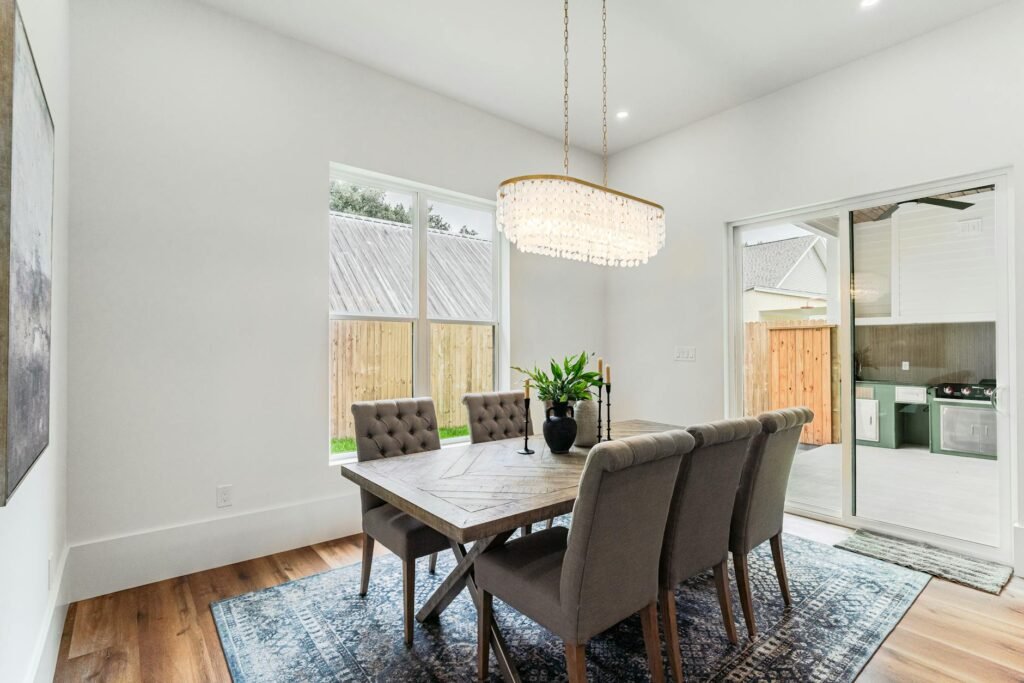
Prior to shopping, evaluate how guests will relate to your space. This is called our Dinner Path Audit. You can complete an audit by scoring each item YES or NO. If you receive two or more NOs, the furniture must be modified prior to spending money on accessories. This order is very important because if you have a furniture arrangement issue, there is no runner or pendant that will fix it.
| Audit checkpoint | What good looks like | What failure means | Lowest-cost fix |
|---|---|---|---|
| Entry view | From the doorway, the eye lands on open floor and the table shape, not furniture packed edge to edge. | The room reads cramped before anyone imagines a meal. | Remove the leaf, center the table, and clear one secondary piece. |
| Chair pull-back | Each chair can slide out naturally without hitting a wall, sideboard, or another chair. | The room is staged for headcount, not for use. | Store two chairs or widen spacing. |
| Pass-behind test | Someone can move behind a seated guest without turning sideways. | Dinner feels awkward and circulation feels blocked. | Remove the buffet or bar cart, or stage fewer seats. |
| Surface cue | The tabletop suggests a real meal: one low centerpiece, maybe simple placemats, no tall obstacles. | The room feels ceremonial, dated, or fussy. | Strip the table back to one simple focal point. |
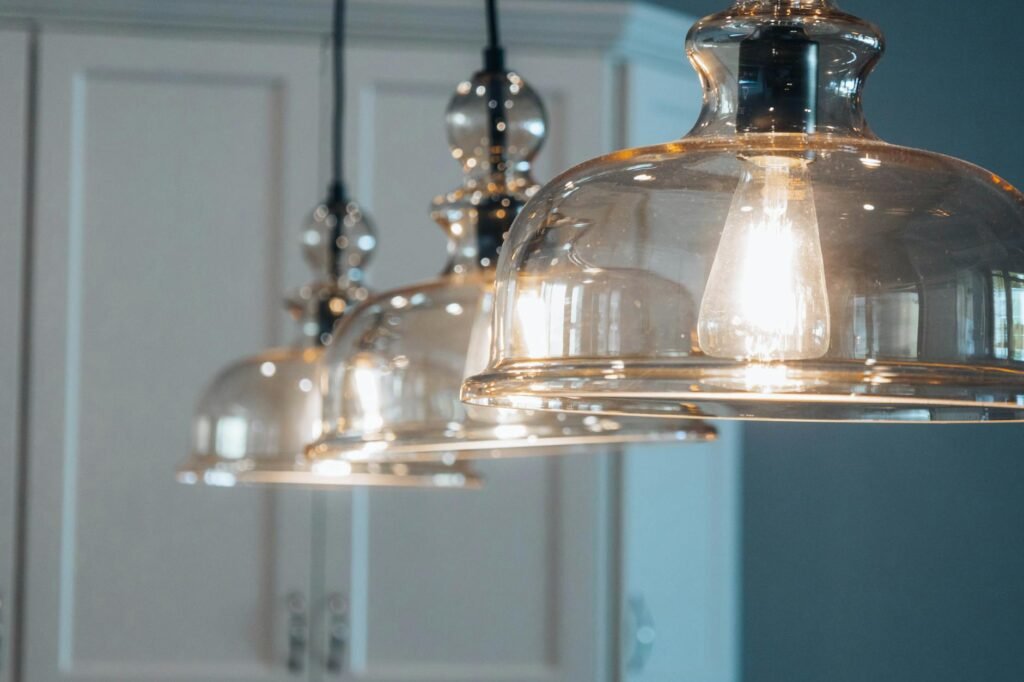
| Light tone | Evening light looks warm and flattering rather than blue or clinical. | The room feels colder than it photographs in daylight. | Use warm indoor bulbs around 2700-3000K or similar warm residential lighting. (energy.gov) |
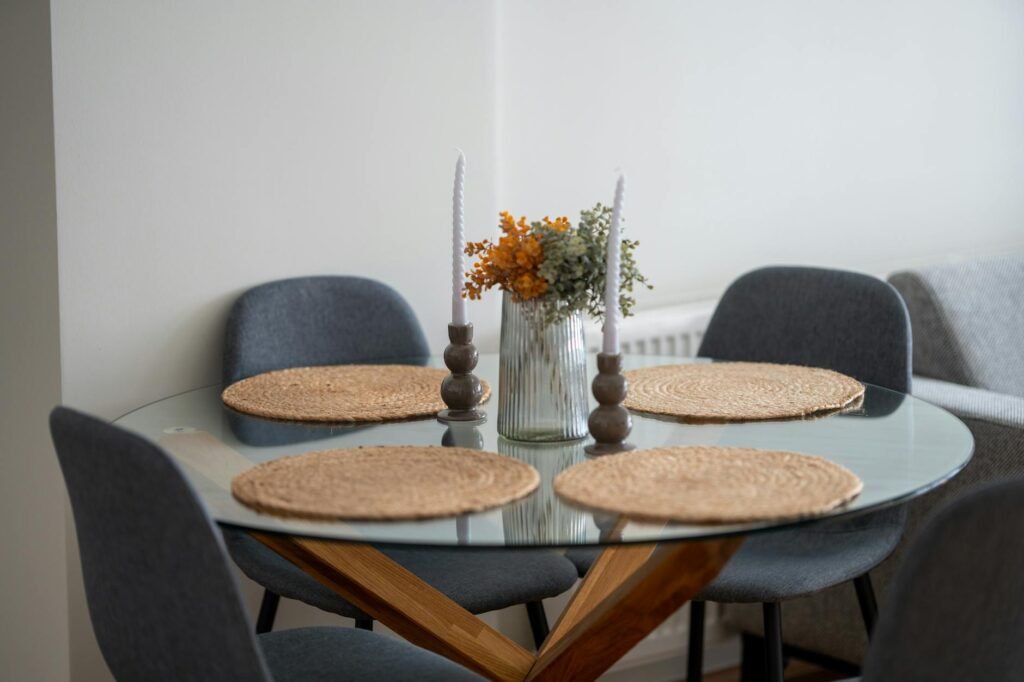
The goal of an evaluation is not for it to be flawless, but for the space to demonstrate an atmosphere of ease. Buyers do not assess your furniture based on how many chairs are available but instead evaluate if they believe the house will be able to accommodate guests.
Why this matters more than a new centerpiece
Good staging is editing, not decorating. NAR’s consumer guide describes staging as presenting the property in its best light through decluttering and styling, not chasing every design trend or remodeling. That is useful discipline in a dining room, because sellers often spend money backward: they add linen, art, candles, and place settings while leaving the oversized footprint untouched. (nar.realtor)
There is also a practical money angle. NAR’s 2025 data found that many agents saw staging help with price or time on market, but those benefits come from helping buyers visualize the home, not from proving that every room can hold the maximum possible furniture. In other words, a $0 furniture edit can matter more than a $700 decor run. (nar.realtor)
A realistic budget example
Composite example: A seller is listing a $465,000 house with a 12-by-13-foot dining room. The room currently has an 84-inch table with the leaf in, eight chairs, a 72-inch china cabinet, a bar cart, and a tall centerpiece. Nothing in the room is cheap, but the space feels like work.
- Professional staging quote for the main floor: $1,200.
- DIY dining-room reset: $0 to remove the leaf, $95 for one month of storage for the cabinet, $36 for warm LED bulbs, $49 for a lower centerpiece, and $80 for one large neutral print. Total: $260.
- Furniture edit: table reduced to six comfortable seats, china cabinet removed, bar cart moved to the kitchen, tabletop simplified.

Resetting will not provide a better offer, but it can make it easier for the buyer to visualize without so much friction in their thinking. In a room this size, sometimes when you have six seats that are relatable, they sell the idea of entertaining in that room better than eight seats that are not. In the event that the seller decides after the fact to spend additional money on staging, the dining room will have already done its job and not clash with the rest of the house.
That is the logic behind spending in stages. NAR reported that 83% of buyers’ agents say staging helps buyers visualize a property as a future home, and nearly half of sellers’ agents in the 2025 profile said staging reduced time on market. A dining-room reset should be judged against that standard: does it help the room make sense faster? (nar.realtor)
The cheapest reset that usually works
- Take everything off the table except one low object.
- Remove the leaf or swap to the smaller tabletop configuration.
- Stage the room with fewer chairs than the maximum if that improves spacing.
- Keep only one large secondary piece, not a buffet, cabinet, and bar cart all at once.
- Replace cool or harsh bulbs with warm residential lighting; the Department of Energy notes that 2700-3600K is generally recommended for most indoor general and task lighting. (energy.gov)
- Use one rug that fully anchors the table setup, or skip the rug if a too-small rug makes the room feel chopped up.
- Re-photograph the room from the doorway and from the corner that will likely appear in the listing.
Notice what is not on that list: buying a full new dining set. In many houses, the fastest win is subtraction.
Common mistakes sellers make after they identify the problem
- They keep the full matching furniture set because it feels wasteful to separate it. Buyers do not care that the collection is complete if the room feels blocked.
- They set a formal table for eight with chargers, tall candlesticks, folded napkins, and seasonal decor. That reads as staged theater, not easy hospitality.
- They add small decor everywhere instead of removing one big piece. Visual clutter is still clutter.
- They leave paperwork, kids’ crafts, exercise gear, or overflow pantry items in the room. A dining room that doubles as storage does not feel entertaining.
- They use cool-toned bulbs that make wood, food, and skin tones feel harsher than they should.
- They ignore the listing photo angle. If the room only works in person after explanation, it is not staged yet.
Several of these overlap with NAR’s list of common staging mistakes, which includes overcrowding, neglecting cleanliness, and using overly bold decor that distracts buyers. (nar.realtor)
When decluttering will not solve it
The issue could simply be that the space is not big enough, doesn’t have an appropriate shape, or is placed incorrectly. However, if removing the furniture doesn’t help this situation, adding different decorations may not resolve the problem either – instead, you should focus on changing how this space is perceived.
- In a narrow room, a round pedestal table can photograph better than a long rectangular one because it reduces hard corners and dead space.
- In an open-plan layout, a smaller dining setup plus a clear pendant or rug can define the zone better than a large formal set.
- If the room is empty or your furniture is badly worn, a one-time staging consultation can be more cost-effective than buying replacement pieces you do not want to keep.
- If you use virtual staging for listing photos, disclose material alterations. NAR’s consumer guide specifically says materially altered photos should be disclosed so buyers get a true picture of the property. (nar.realtor)
The backup alternative that many home sellers simply do not welcome is to furnish the space as it would be used by potential purchasers at that point in time. That is, in some of the homes it could have a casual/ordinary daily eating area (dining room table/setting) versus displaying for use during the holidays (larger table/setting) or to show purpose of breakfast area (breakfast area furniture). Home sellers want to furnish for purpose & not necessarily value (of furniture).
How to pressure-test the setup before photos and showings
- Stand at the main entry point and take a straight-on photo at chest height.
- Pull out every chair as if guests were about to sit down.
- Have one person sit while another walks behind them.
- Turn the lights on after sunset and check whether the room still feels warm; DOE guidance notes that lower Kelvin light appears warmer, while higher Kelvin light looks cooler. (energy.gov)
- Ask someone who has not seen your home before what the room says: dinner, storage, or squeeze.
- Ask your agent whether the room earns a listing photo. If not, keep editing.
This quick test is useful because staging decisions often look fine to the person who lives with them every day. Fresh eyes catch circulation problems fast.
If you can solve the room in 30 minutes by removing furniture, do that before spending a weekend shopping.
Bottom line
The staging error in the Dining Room creates the home to feel less inviting for entertaining. It is in the representation of the maximum number of people that the Dining Room can accommodate compared to representing the comfort level of people coming together in that space. It is generally not more decor that helps to solve these staging problems; it is actually moving out furniture, making a cleaner dining table, creating a warmer light source in the space, and creating a room layout that creates the environment for the potential buyer to imagine hosting a dinner party with friends and family in this space.
If you are selling, think like an editor, not a collector. Cut the extra sentence from the room. What remains should be easy to read.
Frequently asked questions
Should I stage a dining room for six if it can technically seat eight?
Usually, yes. If eight seats make chair pull-back awkward or block circulation, six is often the stronger choice. Buyers read comfort faster than capacity.
Do I need a fully set table to make the room feel ready for guests?
No. A low centerpiece and maybe simple placemats are usually enough. Tall candlesticks, stacked plates, and heavy seasonal decor often make the room feel more formal and less usable.
Is it worth removing a china cabinet or buffet just for showings?
If it makes the room feel tighter, yes. Large case goods are often the first pieces worth storing because they use up wall space and walking space at the same time.
What if my dining room is empty?
An empty room can also underperform because buyers may struggle to judge scale. NAR notes that sellers can use an in-person staging consultation for a do-it-yourself to-do list, and virtual staging can be useful if material photo alterations are disclosed. (nar.realtor)
How much should I spend on dining-room staging before listing?
Start with the lowest-cost layout fixes first. That approach is sensible when NAR reports median staging spend of $1,500 for a staging service and $500 when the seller’s agent stages the home personally. If a smaller furniture footprint solves the room, consider doing that before buying permanent pieces. (nar.realtor)
Should I switch my dining-room bulbs before listing?
Probably. Warm residential light usually feels more flattering than cooler light, and the Department of Energy says 2700-3600K is commonly recommended for most indoor general and task lighting. (energy.gov)
References
- National Association of REALTORS®, 2025 Profile of Home Staging Snapshot – https://www.nar.realtor/infographics/2025-profile-of-home-staging-snapshot
- National Association of REALTORS®, Consumer Guide: Staging Your House for a Sale – https://www.nar.realtor/the-facts/consumer-guide-staging-your-house-for-a-sale
- National Association of REALTORS®, 2025 Profile of Home Staging PDF – https://www.nar.realtor/sites/default/files/2025-05/2025-profile-of-home-staging-05-06-2025.pdf?utm.com=
- U.S. Department of Energy, Lighting Principles and Terms – https://www.energy.gov/energysaver/lighting-principles-and-terms
- Consumer Financial Protection Bureau, What are some of the financial considerations of buying a home? – https://www.consumerfinance.gov/ask-cfpb/what-are-some-of-the-financial-considerations-of-buying-a-home-en-119/