
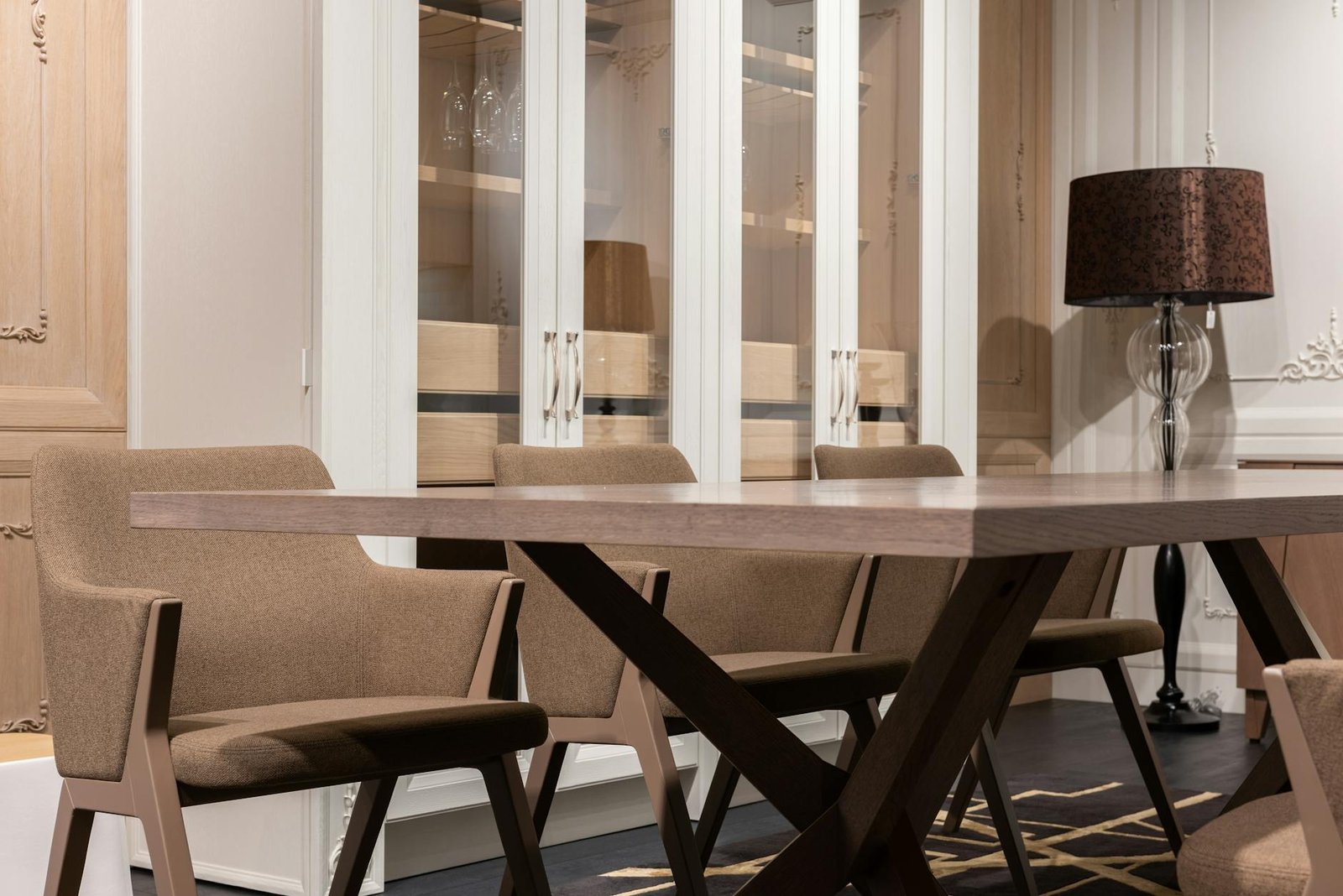
Vacant rooms usually do not appear luxurious due to their lack of furnishings. Most of the time they will seem to be ambiguous: they will have intense light, no focal point, an excessive amount of exposed wall, and no indication of how the room is going to be used. Things that give rooms that impression of being partially done are what cause individuals to purchase more than they should; thus, purchasers will accumulate side tables, additional chairs, additional small shelving, additional baskets, and decorative arts that fill space without providing any enhancement to the room.
The better approach is more edited. A room feels high-end when its purpose is obvious, its scale is controlled, and the few things inside it look intentional. That lines up with basic design principles such as proportion, scale, balance, and emphasis, and it also reflects what home staging research shows: people respond better when a room is easy to read at a glance. In the National Association of REALTORS’ 2025 staging research, 83% of buyers’ agents said staging made it easier for buyers to visualize a property as a future home. (nar.realtor)
TL;DR
- Start with one anchor piece, not a collection of medium-size fillers.
- Use height to create luxury: full-length curtains, a tall lamp, a large mirror, or oversized art.
- Lighting changes the room faster than extra furniture.
- A room looks expensive when it feels intentional, not busy.
- If the need is temporary, renting one key piece can be smarter than buying several placeholders.
Why empty rooms look cheap even when nothing is wrong
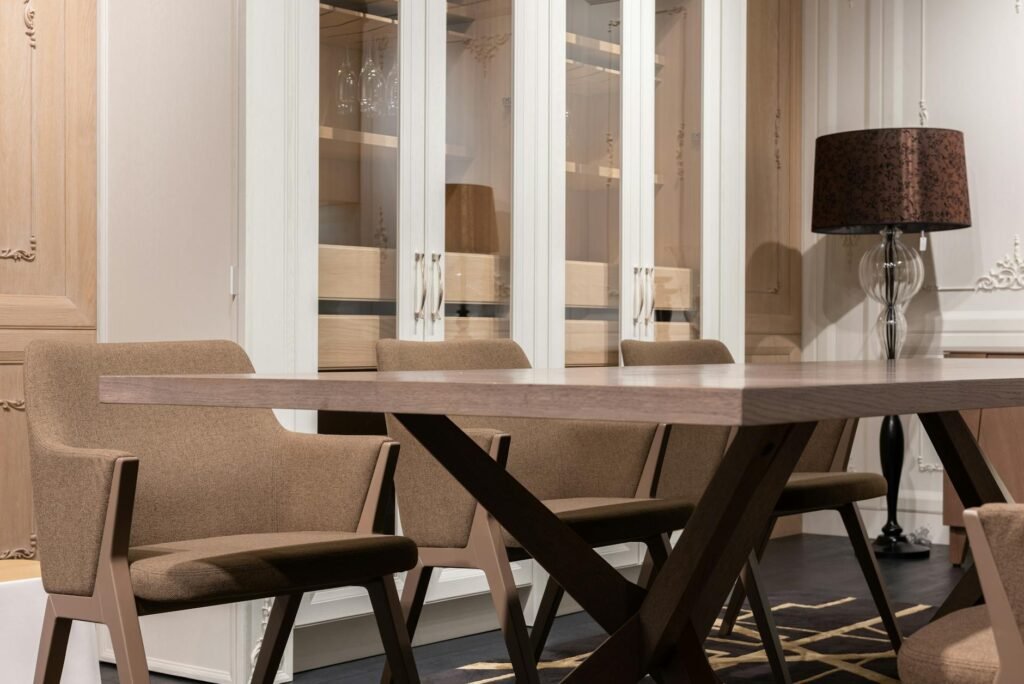
Many rooms that appear to be low-budget share the common issue of an excessive number of functions for their minimal amount of framework. As a result, there is no anchor point in the room and your eye goes to the least pleasing part of the room instead, which might potentially be a small window, a basic overhead light, a crumpled baseboard, a bare wire or a blank corner. Putting more smaller pieces of furniture will usually increase this problem further, as you are putting more objects into the room rather than providing an anchor point for the room.
Most high-end rooms accomplish four objectives. They define a specific function. They choose proportional design, so the focal point of the room appears larger. They create a harmonious balance within the room for an overall visual balance. They provide an area of focus or emphasis, rather than creating many smaller elements. While the room is likely to have minimal decoration, it does not create a feeling of abandonment.
If you are styling a room for a sale rather than everyday living, start with the living room or primary bedroom first. NAR says those were the rooms most commonly staged in its 2025 research. (nar.realtor)
Use the LUXE Room Scorecard before you buy anything
An easy method to prevent over furnishing a space is to first evaluate the room: The room scorecard is designed for rooms with a majority of empty space that will be dressed; but, not completely renovated. There are 3 categories and you give each category a score of 0, 1, or 2. In general, if your total score was either 7 or 8 than you likely would have enough character and style without placing any more furniture in this area.
- L = Lead piece: A room has one significant item that communicates to a visitor in three seconds what the room is about. For example: bed, desk, lounge chair, sofa, bench, or dining table. Score 2 if a room contains at least one substantial item. Score 0 if all of the room’s items are secondary; there is no lead piece.
- U = Upward Pull; a total score of 2 points is earned when something draws my eye up towards the ceiling, and a score of 0 points is given when everything above eye level is covered or blocked. (Note: Total U Score may be affected if one or more walls have high ceilings.)
- X = X out filler. Score 2 if the room can function with very few objects and still feel finished. Score 0 if it depends on multiple little items to avoid looking bare.
- E – Elevation Score 2 is achieved if your room has warm lighting, a consistent finish throughout the room, and uses one or two soft finishes (linens, wool blends, wood, glass, or metal). Score 0 if the finish on your furnishings feels cold, temporary, or mismatched, and lacks warmth or softness.
Understanding The Scale: 0 to 3 = Room unfinished 4 to 6 = Room not finished but functional 7 to 8 = Stop shopping – style what you have already (do not add more). The Importance Of The Scorecard Is That Rooms That Look Expensive Were Usually Edited Out At The Beginning And Will Only Be Made To Look Better As You Add Filler At The End.

| Category | Suggested budget share | Buy, rent, or skip first? | What creates the expensive feel | What to avoid |
|---|---|---|---|---|
| Anchor piece | 40% to 50% | Buy if the room’s use is stable; rent if the need is temporary | One substantial piece with clean lines and real presence | Two or three medium-size stand-ins |
| Rug or window treatment | 20% to 25% | Usually buy | A larger rug or full-height curtains that define scale | Tiny rug, short curtains, or no textile softness |
| Lighting | 15% to 20% | Buy | Two or more warm light sources at different heights | One cold ceiling bulb doing all the work |
| Wall scale | 10% to 15% | Buy, thrift, or reuse | One oversized mirror or art piece | A cluster of small frames trying to fill space |
| Accessories | 5% to 10% | Last priority | A tray, throw, or one book stack that adds finish | Shelf filler and decor bought just to occupy space |
A realistic example: fixing a 10-by-12 spare room with about $1,200
Picture an extra room in a condo, approximately 10 feet wide by 12 ft long with a window, above-ground fluorescent lights, and wooden floors. The owner would like the space to look polished for daily use; it will also function as a reading area, but will ultimately have to use be able to accommodate overnight guests every now and then. The budget is approximately $50,000.
Each of these is an overstuffed Furniture example of the items being understanding as well. It has one of a small accent chair representing $1,030 a narrow bookcase representing $250, a 5-by-7 rug representing $180, two end tables(aka), representing $120, a floor lamp representing $140, large ottoman for storage inheriting from $90, and scatter across several places representing $110,. This creates a situation when you may have filled your corners with furniture; however, no focal point would have been identified in the room due to the rug being too small to be considered a grounding factor, and the accent chair being left alone and the wall space remaining too awkward after looking all these years at what was unexplained.
The reworked version is a more methodical use of the same amount of cash. For instance, the owner is using $280 to get an 8-by-10 rug, $330 for renting a sleeper chair for 3 months while he’s deciding how to lay the room out long-term, $140 for 2 matching lamps, $125 for a rod-set curtain panel that runs up high, $180 for a large mirror, $70 for a throw and pillow, and $50 for touch-up paint and to get cords out of sight. Total cost: $1,175. There are fewer items in the room, but the room feels taller, softer and more intentional.
- The larger rug makes the room read as a complete zone instead of a scattering of edges.
- The rented anchor piece buys time and avoids a rushed purchase.
- Matching lamps bring symmetry and calm without adding bulk.
- The mirror gives the room wall scale without needing another cabinet or chair.
- High-mounted curtains make the room feel taller, which is one of the fastest ways to make a modest room look more expensive.
Spend in this order if you want a high-end look with fewer pieces
- Define the room in one sentence: guest room, reading room, office, dressing room, or flex room. If you cannot describe the room clearly, you will probably buy the wrong things.
- Select an anchor item to use for the space. Look for a focal piece that identifies a room. When decorating a bedroom, the bed will be one of those focal pieces. When decorating a sitting area, the focal piece may be a loveseat, a sleeper chair or a bench. The focal piece for your office will be your desk.
- Add one vertical move. Use curtains, a mirror, art, or a tall lamp to stop the room from feeling low and flat.
- Fix the lighting before adding storage. Better light improves everything already in the room. Extra shelves do not.
- Layer in one soft material. A real rug, textured curtain, or quality throw often does more for the room than another hard-surface furniture piece.
- Stop at the point of clarity. Once the room’s purpose is obvious and the eye lands naturally in one place, extra furniture is usually a downgrade.
Lighting is the fastest way to fake a higher-end room
If the room still looks basic after you place the anchor piece, the next issue is usually the lighting. The Department of Energy separates lighting into ambient, task, and accent uses, and notes that warm light is generally preferred for living spaces. DOE also says 2700K to 3600K is a typical range for most indoor general and task lighting applications, and that a CRI of 80 or higher is acceptable for most residential rooms. (energy.gov)
When a room is empty, it should have at least two sources of light from the ceiling. These could include lamps on tables, floor lamps next to seating areas, or sconces next to the bed. Using warm light bulbs, soft lamp shade materials, and reducing glare create a better “high-end” look than any amount of extra accent tables.
Common mistakes that make a room feel cheaper
- Buying several small furniture pieces instead of one convincing anchor.
- Using an undersized rug that makes every item look like it is floating.
- Pushing everything to the perimeter and leaving a dead, echoing center.
- Relying on one bright overhead bulb, especially if it is too cool or glaring.
- Hanging art too low or using many tiny frames instead of one strong wall statement.
- Ignoring cord clutter, outlet clutter, and visible plastic storage.
- Choosing furniture only because it is on sale, even when the scale is wrong.
- Trying to make the room multifunctional on day one, which often leads to duplicate pieces.
When the first plan is not enough
There are times when you are not under furnishing a room, but rather under finishing a room. If there are markings on the walls of a room, that are present; the trim is chipped; the light fixture is harsh; or the flooring is visually cold, than having fewer pieces of furniture will not give the appearance that the room is “expensive.” In these instances, a repair-first approach typically will become more cost effective than purchasing again.
- If the room feels sterile, add textile weight before adding storage: curtains, a larger rug, or one upholstered piece.
- If the room feels short, prioritize height: curtain rod placement, a tall mirror, or a vertical artwork arrangement.
- If the room feels dark, solve the lighting plan first instead of buying more decor.
- If you move often or expect the room’s job to change within a year, rent the anchor piece rather than buying something you may replace quickly.
- If the budget is tight, improve the room in this order: light, wall scale, textile softness, then furniture.
If children spend time in the home, anchor tall storage pieces and top-heavy furniture. CPSC says unsecured furniture and TVs are hidden hazards, and its consumer guidance notes that many anti-tip kits cost less than $20 and can be installed in fewer than 20 minutes. (cpsc.gov)
How to pressure-test the room before you spend more
- Take one photo from the doorway in daylight and one at night. The room should still look clear and balanced in both.
- Squint at the photo. If your eye lands on cords, empty corners, or a tiny rug, the room still needs editing or better scale.
- Count the real focal points. One is ideal. Two is manageable. More than that usually reads as clutter.
- Remove one nonessential item. If the room improves immediately, you were already drifting into overfurnishing.
- Sit in the room for ten minutes. If the lighting is harsh, the seat feels temporary, or the room still has no obvious use, solve those problems before buying decor.
- Rescore the space using the LUXE method. If you hit 7 or 8, stop.
Bottom line
When you start with just an anchor piece and add a little height and soft furnishings, you can make your space feel much more inviting than by having too many items in a room. If the space is going to be used for a short period of time, it is better economically to rent something unique rather than try to create a collection of inadequate items.
FAQ
What is the single highest-impact purchase for a vacant room?
Most commonly one thing will act as the focal décor item in whichever room you are working on: either the anchor (piece) or rug. If there is no clear defined use for the room, begin with an anchor(s). Conversely, if there is a use but it feels limited, having a larger-sized area rug will typically provide the greatest amount of visual impact.
Is it better to rent furniture or buy it for a mostly empty room?
Renting can be beneficial for short-term needs, such as when you need a temporary home listing, moving somewhere new, have a furnished apartment to rent on a temporary basis, or want to change out your room in the next year.
On the other hand, buying is typically more suited for long-term use items.
A good compromise is to rent the primary/anchor piece of furniture and buy any additional pieces that you can take with you when you eventually get a new place.
Can a room look expensive with secondhand furniture?
Yes. The expensive feel comes from scale, condition, lighting, and restraint more than brand name. One solid secondhand chair or table in the right size will usually look better than three cheap new fillers.
How empty is too empty?
If after a few seconds you are unable to determine what a room is used for because of low or bare walls or cold or temporary lighting, the space has gone-to-unfinished and needs basic structure rather than additional accessories.
What if my budget is only a few hundred dollars?
Do not fully furnish the room; instead try improving the lighting, adding one vertical element and picking one scaled textile as your focal piece of art or furniture. Generally speaking, using a brighter bulb, one lamp, a bigger thrifted mirror and a cleaner wall treatment (paint) will provide better value for your money than purchasing an entire cart of inexpensive accent furniture.
References
- National Association of REALTORS: Profile of Home Staging – https://www.nar.realtor/research-and-statistics/research-reports/profile-of-home-staging
- U.S. Department of Energy: Lighting Principles and Terms – https://www.energy.gov/energysaver/lighting-principles-and-terms
- University of Minnesota: Principles of Design – https://www.takingcharge.csh.umn.edu/principles-design
- U.S. Consumer Product Safety Commission: AnchorIt.gov – https://www.cpsc.gov/Safety-Education/Safety-Education-Centers/AnchorItgov
- U.S. Consumer Product Safety Commission: Military Consumer Safety – https://www.cpsc.gov/Safety-Education/Safety-Education-Centers/Military-Consumer-Safety